All-on-6 Dental Implants
Performed by Prof. Dr. Orçun Toptaş — Maxillo-Facial Surgeon
A full fixed arch on six implants — the most stable option for heavy bites and the upper jaw
Why All-on-6?
All-on-6 restores a full arch using six implants instead of four. The extra support points spread chewing forces further back along the jaw, which is why it is often preferred for the upper jaw, where bone is softer, and for patients with a strong bite.
As with All-on-4, the permanent zirconia bridge is fitted only after 3–4 months of osseointegration, once bone has fully fused to each implant.
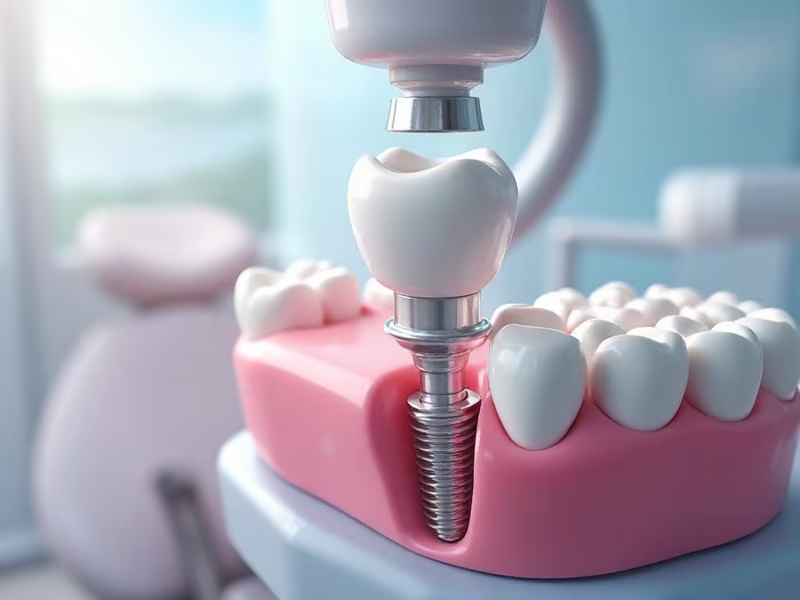
The All-on-6 Process
Six implants only reach their full strength once osseointegration is complete. That is why the final, fully functional bridge is delivered after 3–4 months of controlled healing, confirmed by clinical and radiographic checks.
3D Scan & Planning
Cone-beam CT imaging confirms you have the bone volume to receive six implants and plans their exact distribution along the arch
Implant Surgery
Six titanium implants are placed, mostly axially, so load is shared evenly from the front teeth to the molar region
Healing & Osseointegration
Over 3–4 months bone fuses to each implant surface. With six anchor points the finished bridge tolerates heavier bite forces
Final Zirconia Bridge
After healing is confirmed clinically and radiographically, your permanent full-arch zirconia bridge is designed and fitted
Would All-on-4 be enough?
Four implants mean a shorter surgery and a lower cost, and angled placement often avoids grafting. Your CT scan decides which option fits your bone and bite.
All-on-6 — Frequently Asked Questions
Is All-on-6 better than All-on-4?
Not automatically — it is stronger, but it requires enough bone for six implants. All-on-6 is usually recommended for the upper jaw or for patients with heavy chewing forces.
Why do I have to wait 3–4 months for the final bridge?
Osseointegration — the bonding of living bone to the titanium surface — is what allows the implants to carry a full arch for years. Loading them too early can cause micromovement and bone loss.
Will I be without teeth while healing?
No. A lighter provisional restoration is fitted so you can speak, smile and eat soft foods while the implants heal underneath.
Will I need bone grafting or a sinus lift?
Sometimes. Because six implants need more supporting bone, upper-jaw cases occasionally require a sinus lift or graft. Your CT scan will show whether that applies.
How much does All-on-6 cost compared to Canada or the US?
Treatment in Istanbul typically costs 50–70% less than the same procedure in Canada, the US or the UK, using the same Straumann and Nobel Biocare systems and final zirconia bridges.
Is a titanium bar necessary for All-on-6?
Not in every case, but it is strongly recommended for most full-arch restorations. A milled titanium bar runs inside the bridge and splints all six implants together, so chewing forces are distributed across the whole arch instead of loading one implant at a time. For long spans or heavy bites it significantly improves long-term stability; your CT scan and bite assessment decide whether your case needs one.
Titanium bar vs zirconia-only bridge — which is better?
They solve different problems. A zirconia-only bridge is one solid piece of zirconia: highly aesthetic and very hard, but rigid, so it transmits chewing forces directly to the implants. A titanium-bar design puts a lightweight metal framework inside a zirconia or composite bridge, adding flexibility and making future repairs far easier — a chipped tooth on a bar-supported bridge can often be fixed without replacing the whole arch. Many full-arch cases use the hybrid: titanium bar inside, zirconia outside.
Can a titanium bar fracture?
Fractures are rare when the bar is correctly designed — CAD/CAM-milled from a solid titanium block with adequate thickness for your bite. Problems typically come from under-designed bars, poor fit, or extreme bite forces such as untreated heavy grinding. This is why the bar is designed from your CT and bite records rather than taken as an off-the-shelf part, and why a night guard is recommended for grinders.
How is the titanium bar connected to the implants?
The bar is screw-retained: it sits on abutments attached to each implant and is fixed with small prosthetic screws, passing through the bridge. Nothing is cemented, which means your dentist can unscrew and remove the entire bridge for cleaning, maintenance or repair — a major long-term advantage over cemented designs.
How much does a titanium bar cost in Turkey?
A CAD/CAM-milled titanium bar in Turkey typically costs €640–740 per arch, compared with several thousand in the UK, US or Canada for the same milled framework. It is usually itemised within your full-arch treatment plan rather than charged as a surprise extra — ask for it to be listed explicitly in your quote.
Ready for a Fixed Full-Arch Smile?
Get a free consultation and personalized All-on-6 treatment plan from Prof. Dr. Orçun Toptaş.