Maxillofacial Surgery
Orthognathic (Corrective Jaw) Surgery in Turkey
Realigning the upper and lower jaws to correct bite, function and facial harmony — led by a maxillofacial surgeon.
When Braces Alone Aren't Enough
Some bite and jaw alignment problems originate in the skeleton itself — the upper and lower jaw simply don't meet correctly, no matter how the teeth are straightened. Orthognathic surgery repositions the jawbones themselves to correct the bite, improve chewing, speech and breathing, and bring facial features into better balance.
This is major maxillofacial surgery, led personally by Prof. Dr. Celal Şahin, and it's typically combined with orthodontic treatment before and after surgery as part of one coordinated plan — not something handled separately by unconnected providers.
What Orthognathic Surgery Corrects
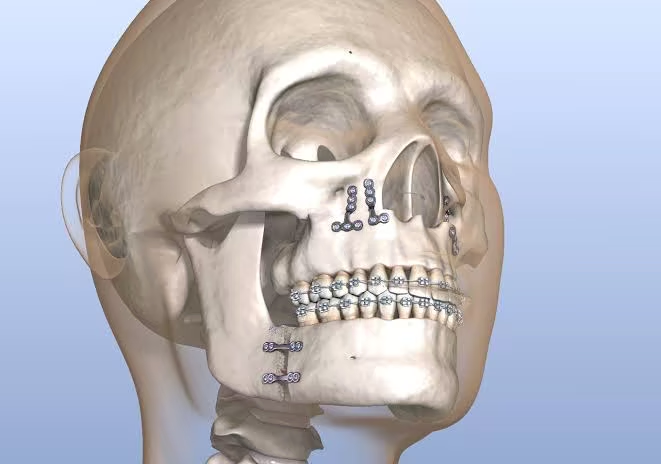
The Orthognathic Surgery Process
A staged treatment plan spanning several months, coordinated around your trips to Istanbul.
Imaging & Surgical Planning
3D imaging maps the exact skeletal correction needed.
Pre-Surgical Orthodontics
Braces or aligners align teeth in preparation for surgery, where needed.
Jaw Surgery
The jawbones are repositioned and secured under general anaesthesia.
Recovery & Final Orthodontics
Healing, followed by any final orthodontic fine-tuning.
Orthognathic Surgery — Frequently Asked Questions
Is orthognathic surgery painful?
It's performed under general anaesthesia, so there's no pain during surgery. Swelling and discomfort during the first 1–2 weeks of recovery are managed with medication.
How long is recovery?
Initial recovery is 2–3 weeks, with full healing and bone stabilization taking several months, during which any final orthodontic adjustments are made.
Do I need braces before jaw surgery?
Many cases require a period of pre-surgical orthodontics to align the teeth first — Prof. Dr. Celal Şahin will confirm this after your imaging and assessment.
How much does orthognathic surgery cost in Turkey?
Corrective jaw surgery in Turkey costs considerably less than equivalent maxillofacial surgery in the UK, US or Western Europe, performed to the same surgical standard.
Will my face look different after jaw surgery?
Yes — that is usually part of the goal. Repositioning the jaws changes the profile and facial balance, which is why the surgical plan is designed in 3D beforehand and you see the planned outcome before committing.
How long do I need to stay in Istanbul for jaw surgery?
Plan for around 10–14 days: surgery, initial recovery and a post-operative check before flying home. Final orthodontic fine-tuning can often be coordinated with an orthodontist in your home country.
Will I be able to eat normally after surgery?
Not immediately — the first 1–2 weeks are a soft/liquid diet while the jaw heals, gradually returning to normal eating over 4–6 weeks. Full bone stability takes a few months, but most patients return to work within 2–3 weeks.
Get a Surgical Assessment
Send your photos and any existing X-rays and Prof. Dr. Celal Şahin will assess whether orthognathic surgery is the right path for your case — completely free.